> ## Documentation Index
> Fetch the complete documentation index at: https://docs.quiva.ai/llms.txt
> Use this file to discover all available pages before exploring further.
# Bot Settings
> Every field on the notetaker's settings form — what it records, where the output goes, and what it says in the meeting
## One form, four places
The same bot settings form appears wherever a bot is configured:
| Where | Applies to |
| --------------------------------------------------------------------------- | ------------------------------------------------------------------- |
| **Settings → Calendars → Add calendar**, step 2 | The defaults for every meeting on that calendar |
| An open calendar's **Settings** cog | The same defaults, edited later — with **Apply to existing bots** |
| The **Bot settings** cog on an upcoming event, or a row in the **Bots** tab | That one bot |
| **Add Bot to Meeting** | The [on-demand bot](/meetings/on-demand-bots) you are about to send |
A bot's settings can only be edited while it is still scheduled to join in the future. Once it has
joined the call there is nothing left to reconfigure, and the cog is replaced by a removal action.
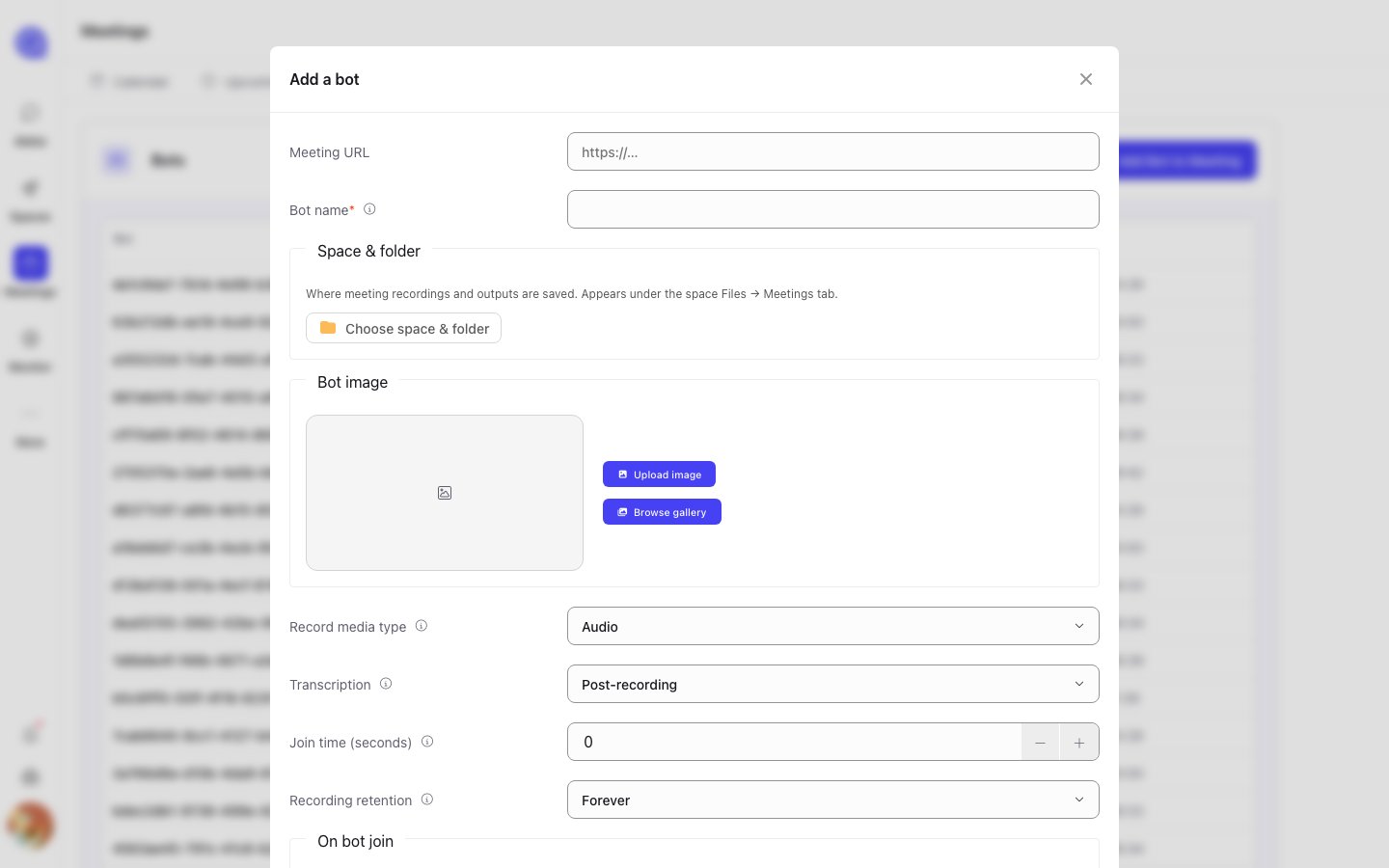 ## Bot name
The participant name shown to everyone else in the meeting. This is what the other attendees see
in the participant list, so make it recognisable — your organisation's name reads better to
external guests than a generic one.
The **Add calendar** wizard pre-fills this with `QuivaWorks Notetaker`. **Add a bot** starts
blank, and will not submit until you give the bot a name.
## Space & folder
Where the meeting's outputs are saved. Choosing a Space and a folder here means the recording,
transcript and summary are filed automatically as soon as they exist — they show up under the
Space's **Files → Meetings** tab.
Press **Choose space & folder** to open the folder picker. Leaving it unset means nothing is filed
automatically; you can still share a recording into a Space afterwards. See
[Sharing to a Space](/meetings/sharing-to-a-space).
## Bot image
The picture the bot shows as its camera feed while it is in the call.
* **Upload image** — a JPG or PNG, cropped to 16:9.
* **Browse gallery** — pick from the images already available in your account.
* **Remove image** — go back to no image.
## Recording
What the bot captures. **Audio**, **Video**, or **Audio & Video**.
When the transcript is produced.
* **Post-recording** — transcribed after the meeting ends.
* **Real-time** — transcribed as people speak. **This is what enables the
[live transcript](/meetings/live-transcript) page.** Without it, there is nothing to follow
during the call.
* **Disabled** — no transcript at all.
How many seconds after the meeting's scheduled start the bot should join. `0` means it joins at
the start time.
**Forever** keeps recordings until you delete them. **Timed** reveals a second field —
**Recording keep (hours)** — after which the recording is deleted automatically.
If you want to follow a meeting live, you must set **Transcription** to **Real-time** *before* the
bot joins. It cannot be switched on mid-call, and a bot that recorded with post-recording
transcription has no live view to go back to.
## On bot join
An optional message the bot posts to the meeting chat when it arrives. Useful for telling the room
that the call is being recorded.
| Field | What it does |
| ----------------------- | ---------------------------------------------------------------- |
| **Message on bot join** | Turns the announcement on |
| **Send to** | **Host**, **Everyone**, or **Everyone except host** |
| **Message** | The text to post |
| **Pin message** | Pins it after sending — **Google Meet and Microsoft Teams only** |
## On participant join
An optional message sent when a *participant* joins, rather than when the bot does.
| Field | What it does |
| ------------------------------- | ---------------------------------- |
| **Message on participant join** | Turns it on |
| **Message** | The text to post |
| **Exclude host** | Do not send it to the meeting host |
These messages are the main way attendees are told a bot is present. The bot is a visible named
participant either way, but an explicit announcement is a good habit — and in some jurisdictions,
a requirement.
## Bot name
The participant name shown to everyone else in the meeting. This is what the other attendees see
in the participant list, so make it recognisable — your organisation's name reads better to
external guests than a generic one.
The **Add calendar** wizard pre-fills this with `QuivaWorks Notetaker`. **Add a bot** starts
blank, and will not submit until you give the bot a name.
## Space & folder
Where the meeting's outputs are saved. Choosing a Space and a folder here means the recording,
transcript and summary are filed automatically as soon as they exist — they show up under the
Space's **Files → Meetings** tab.
Press **Choose space & folder** to open the folder picker. Leaving it unset means nothing is filed
automatically; you can still share a recording into a Space afterwards. See
[Sharing to a Space](/meetings/sharing-to-a-space).
## Bot image
The picture the bot shows as its camera feed while it is in the call.
* **Upload image** — a JPG or PNG, cropped to 16:9.
* **Browse gallery** — pick from the images already available in your account.
* **Remove image** — go back to no image.
## Recording
What the bot captures. **Audio**, **Video**, or **Audio & Video**.
When the transcript is produced.
* **Post-recording** — transcribed after the meeting ends.
* **Real-time** — transcribed as people speak. **This is what enables the
[live transcript](/meetings/live-transcript) page.** Without it, there is nothing to follow
during the call.
* **Disabled** — no transcript at all.
How many seconds after the meeting's scheduled start the bot should join. `0` means it joins at
the start time.
**Forever** keeps recordings until you delete them. **Timed** reveals a second field —
**Recording keep (hours)** — after which the recording is deleted automatically.
If you want to follow a meeting live, you must set **Transcription** to **Real-time** *before* the
bot joins. It cannot be switched on mid-call, and a bot that recorded with post-recording
transcription has no live view to go back to.
## On bot join
An optional message the bot posts to the meeting chat when it arrives. Useful for telling the room
that the call is being recorded.
| Field | What it does |
| ----------------------- | ---------------------------------------------------------------- |
| **Message on bot join** | Turns the announcement on |
| **Send to** | **Host**, **Everyone**, or **Everyone except host** |
| **Message** | The text to post |
| **Pin message** | Pins it after sending — **Google Meet and Microsoft Teams only** |
## On participant join
An optional message sent when a *participant* joins, rather than when the bot does.
| Field | What it does |
| ------------------------------- | ---------------------------------- |
| **Message on participant join** | Turns it on |
| **Message** | The text to post |
| **Exclude host** | Do not send it to the meeting host |
These messages are the main way attendees are told a bot is present. The bot is a visible named
participant either way, but an explicit announcement is a good habit — and in some jurisdictions,
a requirement.